What specific inflammatory process drives the bony changes resulting in a Romanus lesion?
Answer
Enthesitis targeting the vertebral margins
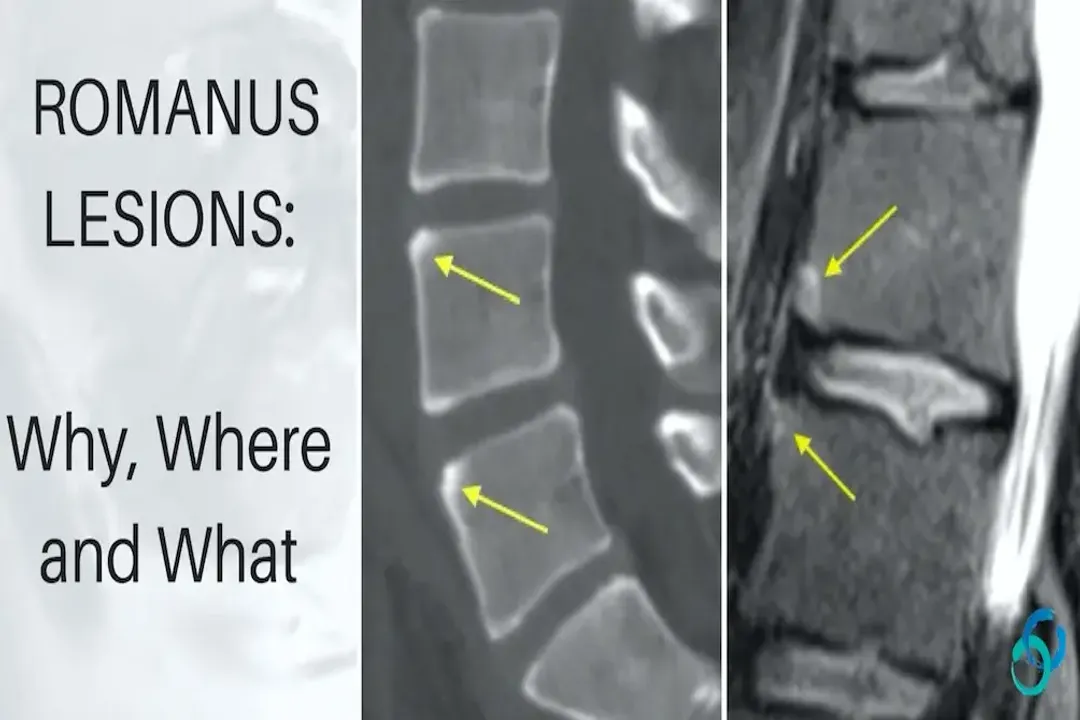
The driving mechanism behind the development of a Romanus lesion is enthesitis. Enthesitis is defined as inflammation occurring precisely where strong connective tissues like tendons, ligaments, or joint capsules attach to bone. In the context of Ankylosing Spondylitis (AS) affecting the spine, this inflammation specifically targets the enthesis at the anterior rim of the vertebral body, which is the attachment point of the tough, fibrous outer layer of the intervertebral disc, known as the annulus fibrosus. This localized immune attack initiates the destructive and subsequent reparative processes characteristic of the lesion.
Related Questions
What specific inflammatory process drives the bony changes resulting in a Romanus lesion?What initial destructive effect on the bone characterizes the nascent stage of a Romanus lesion?What established lesion results from the maturation and extensive repair of an initial Romanus lesion?In which spinal regions are Romanus lesions most frequently identified radiologically?What early finding detectable by MRI reflects the ongoing inflammation in an active Romanus lesion?A key feature distinguishing a Romanus lesion is its dual nature showing both damage and what reparative sign?How does the primary destruction pattern in typical vertebral osteomyelitis contrast with that of a Romanus lesion?The enthesitis causing Romanus lesions specifically targets the insertion point of which structure onto the vertebral body?Identifying a Romanus lesion signals the initiation of the pathological process leading toward what advanced AS spinal feature?On radiographic images, what feature is often what ultimately makes an established Romanus lesion definitively identifiable?