Is Bombay mix good for weight loss?
Bombay mix, that vibrant, crunchy blend often reserved for festive occasions or as a bar snack, presents a complex profile when assessed through the lens of a weight loss plan. It is undeniably popular, a savory treat that offers immediate textural satisfaction and bursts of spice. [1][7] However, whether this beloved mixture supports or hinders goals related to reducing body weight depends entirely on its composition, the quantity consumed, and the context within one's overall diet. [8] Simply labeling it "good" or "bad" misses the nuance inherent in such a diverse snack mix.
# Nutritional Snapshot
The foundational components of traditional Bombay mix are a combination of pulses, cereals, nuts, and spices, often bound together by oil. [2] Typically, you will find ingredients such as split chickpeas (chana dal), green peas, peanuts, gram flour (besan) noodles (sev), and various seasonings like chili powder, turmeric, and salt. [2][7] The presence of legumes and nuts suggests inherent nutritional value, including fiber and some plant-based protein, which are generally beneficial for satiety. [1] For instance, the protein contribution comes largely from the inclusion of lentils and chickpeas. [2]
However, the health perception shifts significantly based on how these components are treated. Many commercial preparations involve deep-frying the flour-based elements and sometimes the peas or lentils, dramatically increasing the fat and calorie content. [1][7] A standard serving of Bombay mix, depending on the brand and exact blend, can hover around the 140 to 170 calorie mark per 30-gram serving, though figures vary significantly across product lines. [3][6][9] For example, one source indicates approximately 160 calories for a serving of a specific brand's Bombay Mix, [9] while another lists a figure closer to 142 calories for a 15g serving, equating to about 284 calories per 30g if scaled, suggesting high variability. [6] A different nutritional database registers about 140 calories for a small, unspecified serving. [3] This range underscores the difficulty in making a blanket statement about its weight loss suitability without knowing the exact source ingredients and preparation method.
# Calorie Load
When aiming for weight loss, achieving a consistent calorie deficit is the primary mechanism. [8] Snacks that are high in calories relative to their volume, often termed "energy-dense," require strict portion control because it is very easy to consume a significant percentage of one's daily calorie budget in just a few handfuls. [8] Bombay mix falls squarely into this energy-dense category primarily due to the oil absorbed during frying. [7]
To put the caloric impact into perspective, consider a common serving size that might be considered a light snack, perhaps 30 grams. If this portion contains, for argument’s sake, 160 calories, [9] that equates to roughly 533 calories per 100 grams. [9] For context, 100 grams of plain cooked chicken breast is typically around 165 calories, and 100 grams of raw broccoli is about 34 calories. The immediate contrast highlights that Bombay mix is substantially more calorically concentrated than many staple whole foods recommended for weight management. [1]
If one is aiming for a 500-calorie daily deficit, consuming a 160-calorie snack means that small portion represents over 30% of the allowed deficit for that entire day. This suggests that, for most individuals managing weight, Bombay mix must be treated as an occasional indulgence rather than a daily staple unless the serving size is severely restricted or the mix is significantly modified.

# Ingredient Impact
Analyzing the components themselves reveals the duality of Bombay mix. On one hand, you have beneficial inputs:
- Legumes (Chickpeas, Lentils): These provide dietary fiber and protein, which contribute to fullness and can slow down digestion. [1][2]
- Spices: Ingredients like turmeric are touted for various health benefits, though their contribution to overall weight loss when consumed in small, dried quantities is marginal compared to the caloric load. [7]
On the other hand, the preparation method introduces significant weight management challenges:
- Frying Medium: The primary caloric culprit is the oil used for frying the sev and puffing the peas or lentils. [7] This process saturates the ingredients with fat, which is the most calorically dense macronutrient at 9 calories per gram. [2]
- Refined Flours: While gram flour (besan) is a pulse derivative and generally better than highly refined white flour, it still contributes a significant carbohydrate load that must be factored into daily totals. [2]
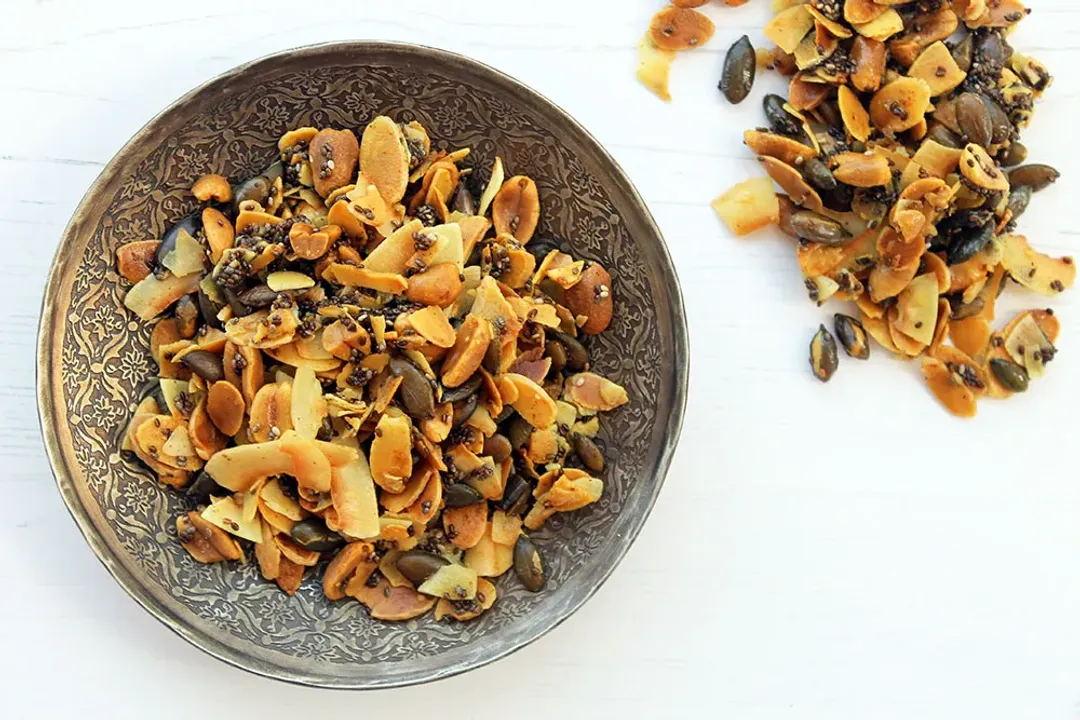
A fascinating contrast emerges when looking at specialized variations, such as recipes for Keto Bombay Trail Mix. These adaptations often seek to maintain the flavor profile while drastically cutting carbohydrate content by swapping out traditional flour-based sev for ingredients like seeds, nuts, and perhaps using a different binder or cooking method altogether, such as roasting instead of deep-frying. [4] While the Keto version might succeed in lowering net carbs, it remains high in fat from the nuts and seeds, meaning its calorie density might remain high, just sourced differently (fat from nuts vs. fat from frying oil). [4] This illustrates that the source of the calories matters for dietary adherence (e.g., low-carb versus low-fat approaches), but the total number of calories dictates weight loss outcomes. [8]
# Portion Control Reality
The primary actionable insight regarding Bombay mix and weight loss is recognizing the disconnect between perceived volume and actual calories. Because it is light, dry, and crunchy, a large visual scoop feels like a small portion, but it can pack a surprising caloric punch.
To create a useful mental benchmark, consider this: If a standard serving is around 160 calories, [9] and you want to limit snacks to 100 calories, you would need to consume roughly 20 grams of the mix instead of 30 grams. That difference of 10 grams is often the difference between one generous handful and a small, controlled sprinkle. For someone accustomed to eating from the bowl, cutting the portion size by a third without realizing it can feel restrictive, making adherence difficult. [8]
A practical check for any snack is comparing its volume to a control. If you decide to limit your Bombay mix intake to 100 calories (about 18-20 grams), try placing that amount on a small plate next to a much larger volume of raw carrots or celery sticks that offer the same calorie count. The visual disparity often highlights how little of the energy-dense snack one can afford. [1] This exercise in visual comparison can be more instructive than just measuring by weight alone, as it relates more closely to the way people actually snack.

# Smart Snacking Adjustments
Given that Bombay mix offers some fiber and flavor complexity not found in plain chips or pretzels, completely eliminating it might not be necessary if one values flavor variety. The key is adaptation and strategic incorporation. [7]
If you enjoy the texture and spice but need to reduce the caloric load for weight loss purposes, one effective strategy involves dilution and modification. [1]
Dilute with Whole Foods: Instead of eating Bombay mix on its own, mix a very small, pre-portioned amount (e.g., 10 grams) into a larger bowl of something nutrient-dense and low in calories, such as air-popped popcorn, roasted chickpeas that you prepared yourself without heavy oil, or even mixed into a hearty salad for a crunchy topping. [1] This provides the flavor "hit" with less overall energy density.
DIY Preparation Scrutiny: When sourcing Bombay mix, try to seek out brands that explicitly state they are baked or air-fried rather than deep-fried, though these options can be harder to find in standard retail settings. [7] If making it at home, controlling the oil content is paramount. For example, if a recipe calls for 1 cup of oil to fry 2 cups of sev batter, reducing that oil to a quarter cup and baking the sev until crisp would drastically alter the final calorie profile, shifting the focus back toward the legume and spice content. [2]
Ultimately, the verdict on Bombay mix for weight loss leans toward caution and moderation. It is not a weight-loss food in its traditional form because its high fat content from frying pushes the calorie density too high for casual consumption. [3][6] It functions best as a small, planned treat—a flavor accent to a balanced day—rather than a go-to high-volume snack meant to stave off hunger between meals. [7] When tracked accurately and kept to small, measured portions, it can certainly fit into a calorie-controlled approach without derailing progress.
Related Questions
#Citations
Bombay Mix - A healthy snack not only for parties | Whole Food Earth®
Calories in Bombay mix - CheckYourFood
Calories in Bombay Mix, Nutrition Information - Nutracheck
Keto Bombay Trail Mix | Carb Manager
Bombay mix chanachur Nutrition - SnapCalorie
Swad In Town Bombay Mix Nutrition Facts - Eat This Much
Why Bombay Mix is More Than Just a Party Favorite
Bombay mix : r/CasualUK - Reddit
Calories in Bombay Mix Savoury Snack by Cofresh and Nutrition Facts