If alone after the initial gasp subsides, what conservation posture should be adopted?
Answer
HELP (Heat Escape Lessening Posture)
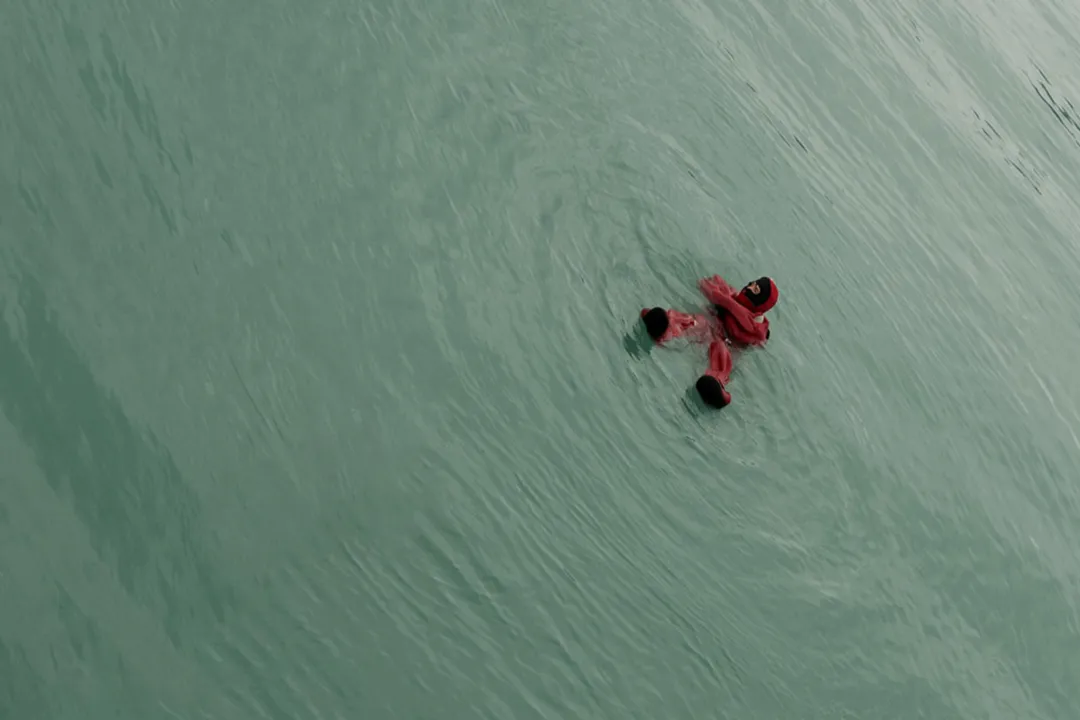
Once the initial Cold Shock phase ends (after about 3 minutes) and the gasp reflex ceases, the goal shifts from airway control to energy conservation to delay systemic cooling and incapacitation. If a person is in the water alone, they should adopt the HELP (Heat Escape Lessening Posture). This specific posture involves crossing the arms tightly over the chest and drawing the knees up towards the chest. This arrangement is crucial because it significantly reduces the surface area exposed to heat loss in the areas where the body loses heat most rapidly, specifically the groin, neck, and armpits, thereby maximizing energy conservation.
Related Questions
What is the typical duration of the Cold Shock Response (CSR)?What is the most hazardous component of the Cold Shock Response?What water temperature defines cold water for triggering the extreme Cold Shock Reaction?What are the primary features triggered by rapid skin temperature drop during CSR?What is the primary goal during the initial 1 to 3 minute Cold Shock window?Which survival phase follows the Cold Shock phase (0–3 Minutes)?What functional decline characterizes the Cold Incapacitation phase (Approx. 3–30 Minutes)?If alone after the initial gasp subsides, what conservation posture should be adopted?Approximately when does the ability to effectively swim or self-rescue end due to incapacitation?In water around $10^{\circ}\text{C}$ ($50^{\circ}\text{F}$), how quickly can significant loss of grip strength occur?