Who came up with radiation therapy?
In November 1895, a single laboratory discovery fundamentally changed the landscape of modern medicine. Wilhelm Conrad Roentgen, a German physicist, noticed a fluorescent glow while working with a cathode ray tube, leading him to identify a new form of energy he dubbed "X-rays". [1][7] Within weeks of this finding, the medical community began to realize that these mysterious rays could do more than just see inside the human body; they could also affect living tissue.
While Roentgen is the namesake of the discovery, the development of radiation therapy was not the work of one single inventor. It was a collaborative, albeit sometimes competitive, evolution involving physicists, physicians, and chemists who raced to harness these rays for therapeutic use.
# The Discovery
Roentgen’s work provided the foundation for everything that followed. By the end of 1895, he had already produced the first radiograph, a landmark event that generated massive interest across the scientific world. [1][5] The medical potential was immediate and visceral. Doctors were not just looking at skeletons; they were witnessing the effects of energy exposure on the skin, which occasionally turned red or burned. These accidental observations acted as the first indicator that radiation might possess the power to kill cells, potentially serving as a tool against illness. [5]
# Early Pioneers
Assigning credit for the "first" use of radiation therapy is complicated because multiple researchers acted almost simultaneously. [3] The lack of standardized communication in the late 19th century meant that several figures in different countries were testing the waters at the same time.
Emil Grubbé, a medical student in Chicago, is frequently cited as one of the first individuals to use X-rays for cancer treatment. In early 1896, just months after the discovery of X-rays, Grubbé reportedly treated a patient with breast cancer. [4][8] His approach was crude by modern standards, utilizing the nascent X-ray technology to deliver doses without any concept of precise measurement or shielding. [5]
However, the French physician Victor Despeignes is often credited with the first published report of radiation treatment in medical literature. In July 1896, Despeignes treated a patient suffering from a stomach tumor. [3][8] He administered daily exposures, and while the patient showed temporary improvement, the cancer eventually returned. Leopold Freund, working in Vienna, also stands out for his successful treatment of a hairy nevus using X-rays in 1896. [5][8]
To better understand these rapid, overlapping developments, consider the chronological progression of these early efforts:
| Date | Pioneer | Location | Focus |
|---|---|---|---|
| Jan 1896 | Emil Grubbé | USA | Breast Cancer |
| Feb 1896 | Leopold Freund | Austria | Nevus (Birthmark) |
| July 1896 | Victor Despeignes | France | Stomach Tumor |
This table illustrates that the early days of radiation were characterized by rapid experimentation rather than a single, isolated "eureka" moment. Doctors were treating conditions ranging from birthmarks to deep-seated malignancies, effectively using radiation as a trial-and-error tool. [5]

# The Curies
While X-rays were the starting point, the discovery of radioactivity by Henri Becquerel and the subsequent isolation of radium by Marie and Pierre Curie expanded the potential for treatment. [1][2] In 1898, the Curies identified polonium and radium, introducing a new method of delivering radiation: brachytherapy, or internal therapy. [5][7]
Radium offered something X-ray tubes of the time could not: a portable, consistent source of radiation. Doctors could place radium needles or applicators directly into or onto a tumor. [6] This "Curietherapy" became the dominant form of radiation treatment for several decades. It allowed for a more concentrated dose of radiation directly to the target area, a significant improvement over the scatter-prone external X-ray beams of the early 1900s. [5]
# Scientific Refinement
By the 1920s, the initial excitement regarding radiation therapy was tempered by a sober reality: patients were experiencing severe side effects. Because the physics of radiation was not fully understood, early treatments often caused significant damage to healthy tissue surrounding the tumor. [5]
This era saw a major shift in methodology, spearheaded by figures such as the French physician Claude Regaud at the Radium Institute in Paris. [5] Regaud recognized that tumor cells and healthy cells respond differently to radiation over time. He proposed the concept of fractionation—breaking the total dose of radiation into smaller, daily doses delivered over several weeks. This approach allowed healthy tissue to recover between treatments while still delivering a lethal dose to the cancer cells. [5][9] This insight remains a cornerstone of modern radiotherapy.
# Megavoltage Era
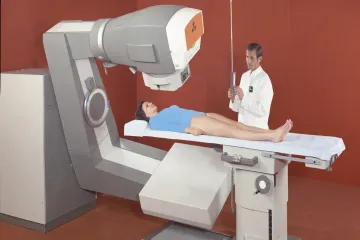
For the first half of the 20th century, radiation treatment remained limited by the energy levels of the machines. X-ray tubes could only generate low or "orthovoltage" beams, which struggled to penetrate deep into the body. [5][7] This meant that deeper tumors were often difficult to treat without burning the skin.
The real transformation occurred in the mid-20th century with the development of the linear accelerator (linac) and the adoption of Cobalt-60 teletherapy units. [5] These machines could produce "megavoltage" beams—high-energy photons that could travel through the skin with minimal surface damage and deposit their energy deep within the body where the tumor was located. [7]
This period marked the transition of radiation therapy from an experimental, often dangerous, practice to a standard, reliable medical specialty. Oncology departments began to separate radiation therapy from general radiology, establishing radiation oncology as a distinct field. [4]
# Modern Practice
Today, radiation therapy is a highly precise discipline. Modern machines use computer-guided imaging to adjust the beams in real-time, matching the shape of the tumor exactly as the patient breathes or moves. [5] This represents a significant deviation from the era of Grubbé and Despeignes, where the "precision" of treatment was often limited to a lead cutout placed over the patient’s skin.
It is worth noting that the history of this field is defined by a slow trade-off between power and safety. Early practitioners prioritized power, often resulting in significant skin damage because they viewed radiation as a blunt weapon. Modern practitioners prioritize the gradient—the difference in dose between the tumor and the healthy tissue. The modern goal is not just to hit the target, but to spare the healthy environment surrounding that target entirely.
One interesting aspect of this history is how it influenced other areas of medicine. The realization that radiation could damage cells led to the discovery of "radiation sickness" and the need for rigorous safety protocols, which in turn fostered early advancements in medical physics. [2][5] The very machines designed to destroy tumors eventually paved the way for advanced imaging technologies like CT scans, which rely on similar principles of physics but are tuned for diagnostic clarity rather than cellular destruction.
The development of this field shows that medical innovation rarely moves in a straight line. It is a series of loops where discovery, application, failure, and refinement repeat until a practice becomes safe and predictable. While we often look for a single inventor, the reality of radiation therapy is that it was built by a global community that recognized the potential in a mysterious, glowing tube and spent a century learning how to control it.
Related Questions
#Citations
History of radiation therapy
The contribution of women to radiobiology: Marie Curie ... - PMC
The First Person to Receive Radiotherapy Treatment
History of Radiation Oncology in the United States
PART I: A short history of Radiotherapy
The Fall Of Radioactive Therapy And Rise Of Radiotherapy
Overview and History | Department of Radiation Oncology
The pioneers of radiotherapy
[100 years radiotherapy. On the birth of a new specialty]
The early history of radiotherapy: 1895–1939