What computational technique models physical movements by solving Newton's laws for every particle in a molecular system?
Answer
Molecular Dynamics (MD)
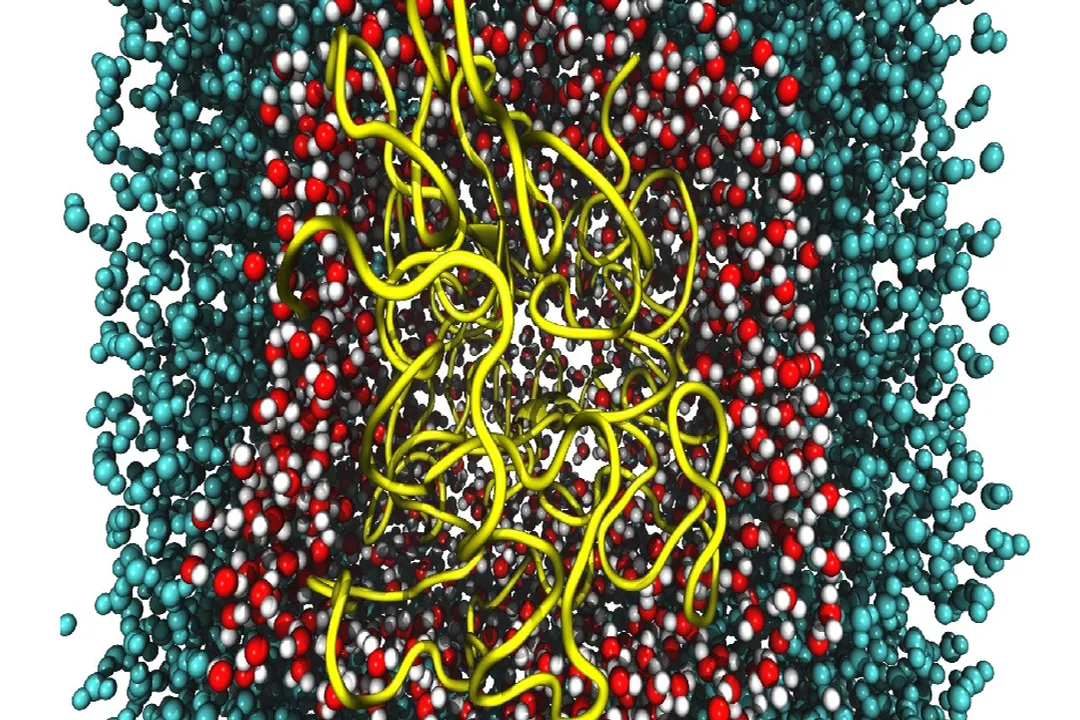
Molecular Dynamics (MD) is the specific computational technique employed to model the physical movements of atoms and molecules within a system. This modeling is achieved by numerically solving Newton's laws of motion, which dictates the forces acting upon each individual particle based on its current position relative to all other particles in the system. Unlike static methods that provide only a single snapshot, MD generates a time-dependent trajectory, effectively creating a 'movie' that shows the dynamic behavior critical for understanding drug interactions within the complex, shifting environment of biological machinery.
Related Questions
What computational technique models physical movements by solving Newton's laws for every particle in a molecular system?What specific time unit, representing one quadrillionth of a second, is often used to measure the very small time steps in MD calculations?When assessing a potential drug target before synthesis, what early stage MD simulation application determines its structural viability in a body-mimicking environment?Which metric derived from MD simulations offers a quantitative measure of binding strength that directly correlates with a drug's effectiveness at lower concentrations?What simulation output, related to flexibility and complex stability over time, helps identify unwanted ligand flapping in drug candidates?What principle explains why researchers might use MD to rigorously test a few hundred candidates instead of screening millions using faster methods?According to the provided simulation metrics table, what information does the 'Water/Ion Movement' observation suggest ways to modify a drug for better performance?In the practical example with Compound C, what molecular feature caused a time-dependent steric clash that forced the inhibitor into a less effective pose?What essential information can MD simulations provide about a solved experimental structure, such as one from X-ray crystallography, that the static structure itself misses?What major limitation, often involving large domain rearrangements, currently hinders the ability of MD simulations to model important biological events accurately?