What is the normal day cycle of a period?

That month-to-month regularity many people associate with their period is often less a strict calendar event and more a dynamic biological process spanning several weeks. When people ask about the "day cycle of a period," they are usually referring to the entire menstrual cycle, which begins on the first day of menstrual bleeding and concludes the day before the next period starts. [1][2][7] Understanding this cycle means looking beyond just the days of bleeding to encompass the complex interplay of hormones preparing the body for potential pregnancy each month. [1][7] It’s a system that can naturally vary quite a bit, depending on age, general health, and other personal factors. [3][5]
# Cycle Phases
The menstrual cycle is conventionally broken down into four primary phases, each orchestrated by fluctuating levels of reproductive hormones, primarily estrogen and progesterone. [1][7] These phases repeat consistently as long as a person is fertile and not pregnant. [7]
# Menstruation Onset
The first phase, menstruation, is what most people call a period. [1][2] This phase begins on day one of the cycle. [2] It occurs because the thickened lining of the uterus (the endometrium), which built up in the previous cycle in preparation for a fertilized egg, is no longer needed. [1][7] Without pregnancy, hormonal signals cause this lining to break down and shed, resulting in menstrual bleeding. [1][7] This phase typically lasts anywhere from two to seven days. [2]
# Follicular Growth
Following menstruation, the follicular phase begins, running concurrently with the early days of bleeding. [1] During this stage, the pituitary gland releases follicle-stimulating hormone (FSH), which prompts several follicles in the ovaries to begin developing. [1] Each follicle contains an immature egg. [1] Usually, only one follicle will mature fully; this dominant follicle produces rising levels of estrogen. [1][7] The primary role of this rising estrogen is to signal the uterine lining to start rebuilding and thickening again, preparing the uterus for a potential implantation. [1][7] This phase is often the most variable in length across different cycles. [4]
# Ovulation Timing
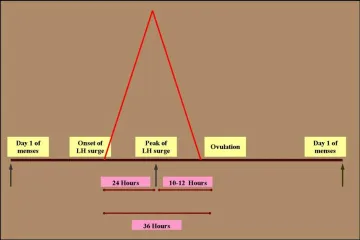
The surge in estrogen eventually triggers a sudden release of luteinizing hormone (LH) from the pituitary gland, an event known as the LH surge. [1] This surge causes the dominant follicle to rupture and release the mature egg from the ovary—this event is ovulation. [1][2][7] Ovulation is the key fertility window of the cycle and usually occurs around the middle of the cycle, though the exact day is highly dependent on the length of the preceding follicular phase. [4]
# Luteal Preparation
The final phase is the luteal phase, which starts immediately after ovulation and lasts until the next period begins. [1][7] Once the egg is released, the ruptured follicle transforms into the corpus luteum. [1] The corpus luteum produces large amounts of progesterone, with estrogen also present. [1][7] Progesterone’s main job is to keep the uterine lining thick, blood-rich, and stable to support an early pregnancy. [1][7] If the egg is not fertilized, the corpus luteum breaks down about ten to fourteen days later. [1][7] This drop in progesterone and estrogen levels signals the uterus to shed its lining, starting the entire cycle over again with menstruation. [1][7]
# Standard Duration
It is common for people to assume that every menstrual cycle lasts exactly 28 days, but this is a significant oversimplification of human biology. [8] A cycle length is considered normal if it falls within a specific, wider range. [2]
# Cycle Length Range
While a 28-day cycle is often used as a benchmark, a cycle can be deemed normal if it ranges anywhere from 21 to 35 days. [2][4] This means that a person whose cycle reliably runs for 24 days or 34 days is still operating within a typical biological pattern. [2][9] The key factor for health is often consistency within an individual's personal range, rather than adhering rigidly to the 28-day average. [8] Cycles shorter than 21 days or longer than 35 days may warrant a conversation with a healthcare provider to investigate underlying causes. [2] For example, cycles stretching past 35 to 45 days, though sometimes occurring, are generally considered long and might indicate an anovulatory cycle (a cycle without ovulation). [9]
# Bleeding Days
The actual bleeding time, menstruation itself, is much shorter than the overall cycle length. [2] Most individuals experience bleeding for about two to seven days. [2] If bleeding lasts longer than seven days consistently, or if bleeding is so heavy that it significantly disrupts daily life, that moves outside the common definition of normal flow. [2]
It is helpful to establish a personal baseline for cycle length. If you track your cycle for several months, note that if your follicular phase is short, your overall cycle shortens, and if the luteal phase is extended (which is rare as it is usually fixed around 14 days), the cycle lengthens. [4] An interesting point to consider in tracking is that the length of the luteal phase—the time between ovulation and the next period—tends to be quite stable, often around 14 days. [4] This means that most variations in overall cycle length come from changes in the follicular phase—the time leading up to ovulation. [4][8]
Tracking Consistency
To gauge your personal rhythm, tracking your start dates for at least six consecutive cycles provides a more meaningful picture than just one month's data. If your longest cycle is 32 days and your shortest is 28 days, your normal range is a four-day window. If one month jumps to 40 days without a clear external cause like significant stress or travel, that deviation of 12 days outside your norm is more noteworthy than if your usual range spans 10 days. [8]
# Age Variations
The body’s hormonal regulation shifts over a person’s lifetime, meaning what is considered a "normal" cycle day count can change significantly between adolescence and later reproductive years. [3][5]
# Adolescent Cycles
When periods first begin, typically between the ages of 10 and 15, cycles are often irregular. [3] It can take several years for the body’s hormones and the ovaries to establish a reliable, predictable rhythm. [3] For new menstruators, it is common to have cycles that are significantly longer or shorter than the 21-to-35-day range adults settle into. [3]
# Mid-Life Changes
As someone approaches their late 30s and early 40s, the body begins to prepare for perimenopause. [3] During this transition, the ovaries may start producing less estrogen, which can lead to shifts in cycle length. [3] Some individuals might notice their cycles becoming shorter, perhaps consistently running closer to 24 or 25 days, while others might experience longer cycles. [3] These fluctuations are a common part of the aging reproductive system. [3]
It has also been observed that demographic factors can play a subtle role in cycle timing. Research suggests that cycles among women of Asian descent tend to be slightly shorter, while those reported by women of Hispanic or Black descent may be slightly longer on average compared to white women, though these are broad population trends and individual variation remains the most important factor. [5]
# External Influences
The menstrual cycle is not isolated from general physical health or external pressures; many factors can influence its timing and length. [5]
# Body Mass Index
Body weight, particularly how it relates to height (Body Mass Index or BMI), influences the hormones that govern the cycle. [5] Being significantly underweight or overweight can interfere with regular ovulation, leading to cycles that become either unusually long or stop altogether. [5] For example, very low body fat can stop the production of enough estrogen to maintain a cycle. [5] Conversely, excess body fat can sometimes lead to higher circulating estrogen levels, which can also disrupt the delicate timing needed for ovulation. [5]
# Intense Activity
Extreme physical exertion, such as that experienced by high-level endurance athletes, can also put the system into a temporary state of stress that pauses or significantly alters the cycle length, sometimes leading to missed periods entirely due to energy deficits or hormonal changes. [5]

# When Cycles Shift
Because the normal range is wide (21 to 35 days), it takes more than one "off" cycle to signal a problem. [2] However, persistent irregularities suggest that the delicate balance of hormones may be disrupted and requires attention. [2]
You should consult a healthcare professional if:
- Your periods stop completely for more than three months when you are not pregnant, breastfeeding, or going through menopause. [1][2]
- Your cycles consistently run shorter than 21 days or longer than 35 days. [2]
- Your bleeding lasts longer than seven days. [2]
- You experience very heavy bleeding that soaks through protection quickly. [2]
If you are trying to conceive, understanding the timing of ovulation is critical, as this is the only time intercourse can result in pregnancy. [4] Knowing your average cycle length allows you to roughly estimate when that fertile window will occur, even if the exact day shifts slightly month to month. [4] For a typical 28-day cycle, ovulation is estimated around day 14, but for a 32-day cycle, it’s closer to day 18. [4] Consistent tracking provides the data necessary to make these estimations more reliable over time. [8]
Related Questions
#Citations
Menstrual Cycle (Normal Menstruation): Overview & Phases
Normal Periods Menstrual Cycle Basics
What is a normal period cycle in your 20s, 30s and 40s? - Allina Health
Periods and fertility in the menstrual cycle - NHS
how menstrual cycles vary by age, weight, race, and ethnicity
What Does Your Menstrual Cycle Say About Your Fertility?
The menstrual cycle | Better Health Channel
The 28-Day Cycle Is a Myth: Here's What You Need to Know
Is a 35-45 day menstrual cycle normal? - Vinmec