What is the best time to have sleep?

The quest for the perfect bedtime isn't about finding a single hour stamped on a universal clock; it’s a personalized equation balancing the necessary quantity of sleep with the body’s internal timing mechanism. While many seek a definitive answer, the reality is that the "best" time is fundamentally tethered to two variables: how much sleep you need and what time you must wake up. [1] Understanding this interplay between duration and rhythm is far more valuable than chasing an arbitrary 10:00 PM goal.
# Sleep Quantity Needs

Before pinpointing the time you should be drifting off, you must first establish the required duration. Sleep needs are not uniform; they shift dramatically throughout the lifespan. [6] For the vast majority of adults, experts recommend securing between seven and nine hours of sleep per night to support optimal health and cognitive function. [1][7] This range is essential for processes ranging from physical restoration to memory consolidation. [5]
For younger individuals, the requirement is higher. Teenagers generally need between 8 and 10 hours, while school-aged children often require 9 to 12 hours. [6] When you fall short of your personal requirement—say, consistently getting six hours when you need eight—you are accumulating a sleep debt that impacts alertness, mood, and long-term wellness. [4] This baseline quantity dictates the starting point for any bedtime calculation.
# Circadian Timing

Beyond the sheer hours, when you sleep matters because our bodies operate on an approximately 24-hour cycle known as the circadian rhythm. [1] This internal clock regulates nearly every bodily function, including hormone release, body temperature, and the drive to sleep and wake. [4] When your sleep aligns with your natural rhythm, the sleep you get is more efficient and restorative.
Some research hints at a specific sweet spot for overall health benefits. Studies suggest that individuals who fall asleep between 10:00 p.m. and 11:00 p.m. may experience better health outcomes compared to those sleeping later. [9] This timing aligns reasonably well with when the body naturally prepares for deep rest, as the production of the sleep-promoting hormone, melatonin, typically peaks in the late evening. [1] However, it is crucial to remember that a person who is a natural "night owl" might thrive on a 1:00 a.m. to 9:00 a.m. schedule just as well as an early bird thrives on 10:00 p.m. to 6:00 a.m., provided they meet their sleep duration requirement consistently. [6] The key is alignment with your personal rhythm, not necessarily the societal standard.

# Sleep Stages
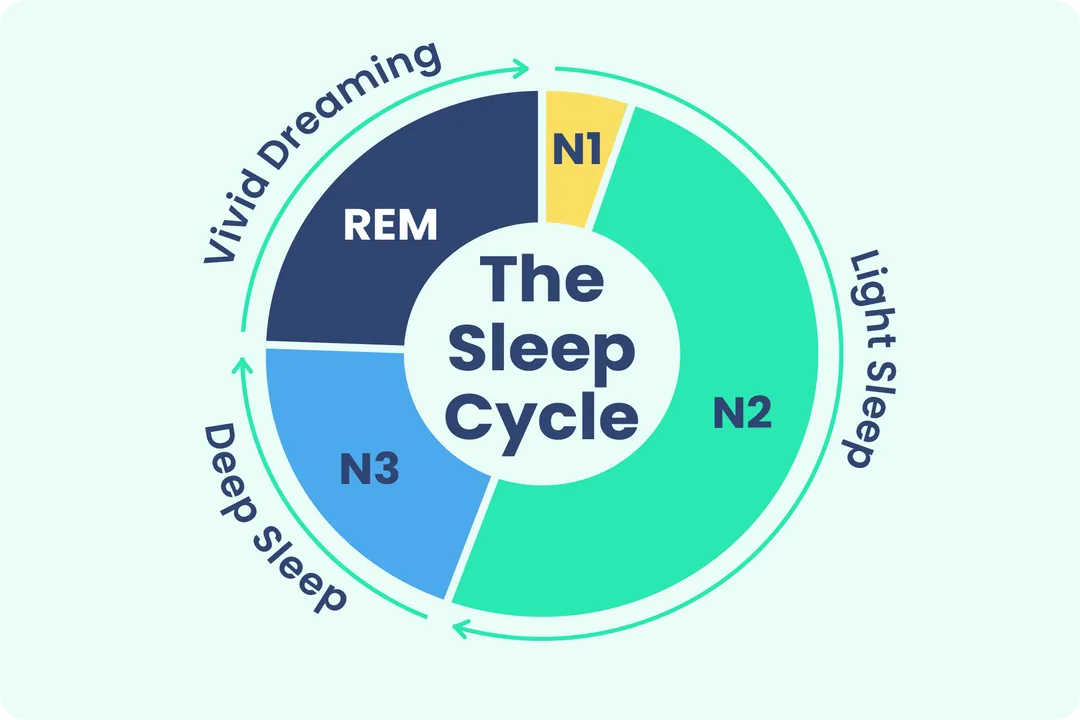
The time you choose for sleep directly influences the proportion of time spent in the vital stages of sleep, namely deep sleep and REM sleep. [2] These stages occur in cycles that last about 90 minutes, and their distribution is not static across the night.
- Deep Sleep (Slow-Wave Sleep): This physical restoration phase, critical for tissue repair and growth hormone release, tends to dominate the earlier part of the night. [5]
- REM Sleep (Rapid Eye Movement): This stage, essential for emotional regulation and memory processing, becomes more prominent in the later cycles closer to morning wake-up time. [2][5]
If you consistently cut your sleep short—for example, waking up after only five or six hours—you are disproportionately depriving yourself of REM sleep, which occurs later in the cycle. [5] If your goal is to maximize both physical recovery and cognitive consolidation, ensuring a full 7 to 9 hours allows your body to move through all necessary cycles uninterrupted. [1][2]
# Calculating Bedtime

Once you know your necessary sleep duration (say, 7.5 hours) and your fixed wake-up time (say, 6:30 a.m.), you can work backward to establish a target bedtime. Many online tools are designed to help with this conversion, often factoring in the 90-minute sleep cycles to help you wake up at the end of a cycle for better morning grogginess reduction. [3][7]
Here is a basic working backward model for an adult requiring 8 hours of sleep, aiming for a 6:30 a.m. wake-up:
| Wake Time | Required Hours | Target Sleep Time (Simple Subtraction) | Cycle-Adjusted Target (Subtracting 15 min buffer + 8 hours) |
|---|---|---|---|
| 6:30 a.m. | 8 hours | 10:30 p.m. | 10:15 p.m. |
| 6:30 a.m. | 7.5 hours | 11:00 p.m. | 10:45 p.m. |
If you want to wake up feeling relatively refreshed, adding a 15-minute buffer before your actual target time accounts for the time it takes to fall asleep initially. If you need 7.5 hours (five full 90-minute cycles), and you need 15 minutes to drift off, you should aim to be in bed by 10:45 p.m. to achieve 7.5 hours of actual sleep by 6:30 a.m.. [1]
You can test this calculation. If your required sleep is 8 hours, and you are frequently waking up at 6:30 a.m. feeling unrested, the issue might not be the bedtime itself, but rather the quality of sleep leading up to that time, perhaps due to external disruptions or an underlying rhythm mismatch. [4]

# Rhythm Consistency
While the calculation provides a starting point, consistency is arguably the single most powerful component of establishing a healthy sleep pattern. [6] Going to bed at 10:30 p.m. one night and 1:00 a.m. the next—even if you catch up on sleep on the weekend—disrupts your body’s established timing signals. This disruption can be compared to frequently moving across time zones, sometimes called "social jetlag". [4][6]
When your bedtime fluctuates wildly, your body struggles to anticipate when to release hormones like melatonin and cortisol, leading to poorer sleep initiation and maintenance on the nights you attempt to adhere to an earlier schedule. A fixed wake-up time serves as the anchor for your circadian system. [1] Maintaining that anchor, even on non-work days, helps solidify the rhythm, making it easier to fall asleep naturally when the time comes. [6] Think of your wake-up time as the fixed point on the compass; your bedtime then becomes the magnetic bearing that should remain steady relative to that point.
# Personalizing the Window
The traditional recommendation of early bedtime works best for those whose natural alertness window closes around 10:00 p.m. or 11:00 p.m. However, some individuals have a biologically later chronotype—they are naturally programmed to feel alert later in the evening and wake later in the morning. [9] For these individuals, forcing a 10:00 p.m. bedtime can lead to frustration, lying awake, and increased anxiety about not sleeping, which ultimately makes falling asleep harder.
Here is a way to fine-tune your calculated bedtime: Treat your calculated target time—say, 11:00 p.m.—as a fluid target for the first week of observation. If you consistently get into bed at 11:00 p.m. but don't feel tired until 11:45 p.m., and you are still getting your required 8 hours (waking naturally at 7:45 a.m.), then shift your target bedtime back by 45 minutes to 11:45 p.m. for the following week. Conversely, if you are nodding off within minutes of lights-out at 11:00 p.m. and wake up feeling fatigued before your alarm, you might be getting too much sleep or need to shift earlier to optimize your deep sleep timing. The goal is to find the intersection where the calculated need meets the biological readiness. [1] This iterative process respects the biological reality that our internal clocks have individual settings.

# Preparing for Rest
The best time to sleep is irrelevant if the preceding hour actively fights your body’s transition into sleep mode. The hour before your target bedtime should be dedicated to winding down the mind and body, signaling to your system that the active day is over. [4] This involves dimming lights, avoiding mentally stimulating or stressful activities, and limiting exposure to bright screens, as blue light suppresses melatonin production. [1]
Many people mistakenly believe they need to "force" sleep to happen at a certain time, leading to frustration. Instead, focus on the pre-sleep routine. If your target is 11:00 p.m., start your wind-down sequence at 10:00 p.m. The true best time to sleep isn't just the hour you close your eyes, but the transition period that ensures your body is physiologically primed to use that time effectively. [4] Prioritizing this transition period maximizes the restorative value of every minute you spend asleep, regardless of whether your ideal bedtime falls on the earlier or later side of the spectrum. [6]
Related Questions
#Citations
The Best Time To Go to Sleep - Cleveland Clinic Health Essentials
What Time You Should Go to Bed by Wake-Up Time and Age
Sleep Calculator: Ideal Bedtime & Wake Up Times - Sleepytime
Assess Your Sleep Needs - Division of Sleep Medicine
How Much Deep, Light, and REM Sleep Do You Need? - Healthline
8 hours isn't the golden rule for sleep. You might only need 6 | CNN
Sleep Calculator: What Time You Should Wake Up and Go to Bed
Best Time to Sleep for Wellness and Vitality - Dr. Tashko
There appears to be an optimal bedtime - between 10pm and 11pm