Is a prescription required for heliox?
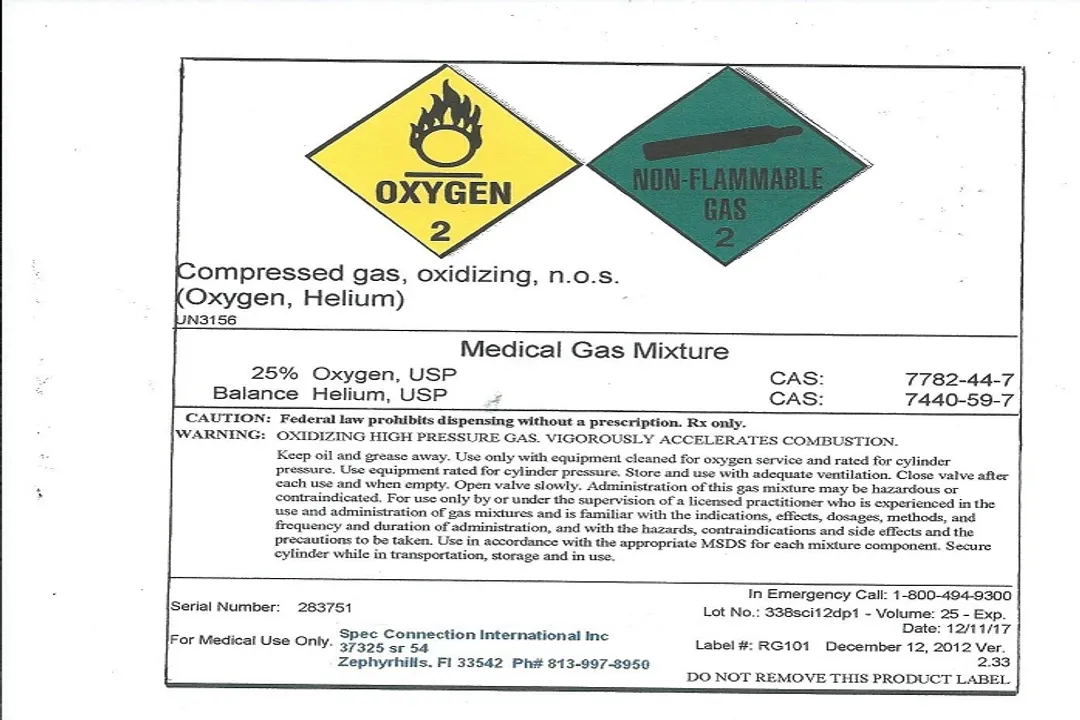
The administrative pathway for accessing Heliox, the mixture of helium and oxygen, immediately directs users to the formal structures of healthcare, rather than over-the-counter availability. For any patient treatment involving this gas, a clear authorization pathway exists, rooted in its classification as a therapeutic agent. Documents detailing the product labeling consistently mark Heliox as "Rx only". Furthermore, the formal labeling explicitly cautions that "Federal law prohibits dispensing without a prescription". This regulatory mandate is echoed in documentation for associated dispensing equipment, which states the device is restricted to sale "by or on the order of a physician". This fundamental requirement underscores that Heliox is not a substance one can simply purchase or possess without clinical oversight; medical gases, in general, are considered drugs and require recommendation from a licensed professional.
The necessity of a prescription stems directly from the specialized nature of the treatment and the inherent hazards associated with compressed gases. Administration must occur only by or under the direction of a licensed practitioner experienced in managing gas mixtures, understanding the specific indications, effects, dosages, and necessary precautions. When considering a medical gas mixture like Heliox, the patient's physician or an overseeing licensed practitioner, often a respiratory therapist, must prescribe the exact blend and duration for therapy.
# Gas Composition
At its foundation, Heliox is a precisely manufactured combination of two primary components: helium (He) and oxygen (). While the air we breathe normally consists of roughly 21% oxygen and 78% nitrogen, Heliox substitutes the relatively heavy nitrogen with much lighter helium.
The power of this substitution lies in physics. Helium has a significantly lower density than nitrogen. When these gases are combined, they form a mixture that is less dense than atmospheric air, which directly translates to reduced resistance as the gas travels through the respiratory system. This is why Heliox is primarily indicated for individuals struggling with breathing due to obstructions or conditions that increase airway resistance.
Clinicians commonly employ two standard mixtures, though others exist:
- 80/20 Heliox: 80% Helium and 20% Oxygen.
- 70/30 Heliox: 70% Helium and 30% Oxygen.
The specific mixture chosen is dependent on the patient’s current oxygen saturation needs. A lower percentage of oxygen (like in the 80/20 blend) might be chosen if the patient's blood oxygen levels can be maintained with less supplemental , allowing for a greater concentration of helium to maximize the density benefit. For instance, a common 70/30 blend is noted to be about 2.3 times less dense than air, while an 80/20 mix approaches three times less density.
# Mechanism of Action
The therapeutic effect of Heliox is achieved by manipulating the way gas flows through the airways, a concept governed by fluid dynamics principles like the Reynolds number. Airflow through the lungs has three regimes: laminar, transitional, and turbulent.
- Turbulent Flow (Large Airways): In the larger central airways, airflow is often turbulent. In this regime, resistance is proportional to the density of the gas. Because Heliox is less dense, the resistance drops substantially, making it much easier for the air to move in and out.
- Laminar Flow (Small Airways): In the smaller peripheral airways, flow tends to be laminar. Here, resistance is chiefly related to gas viscosity, which is similar between air and helium, meaning Heliox offers little advantage in these tiny passages.
Because the primary mechanical benefit occurs where resistance is highest—the large airways—Heliox is exceptionally useful when obstructions are present there. The gas mixture reduces the overall "work of breathing" (WOB), lessening the fatigue on respiratory muscles. This offers an emergency pathway to stabilize a patient, acting as a bridge while definitive treatments for the underlying cause—such as resolving a severe asthma attack or reducing inflammation—take effect. The positive effects are often noted quite quickly, sometimes within an hour of starting therapy.
# Clinical Applications
Heliox is employed across various acute respiratory distress scenarios where simple oxygen delivery is insufficient due to compromised flow dynamics. Its role is not to treat the disease itself but to ease the physical burden of respiration.
Conditions frequently managed with Heliox include:
- Upper Airway Obstructions: This is a primary indication, covering issues like laryngeal obstruction, subglottic stenosis, or blockages caused by tumors or foreign bodies.
- Severe Bronchospasm: In cases of status asthmaticus or severe asthma exacerbations, Heliox helps bronchodilator medications penetrate further into the airways.
- Post-Extubation Stridor: Patients who have had an endotracheal tube removed may experience noisy breathing (stridor) due to airway inflammation; Heliox can smooth this airflow during recovery.
- COPD Exacerbations: Similar to asthma, it assists in managing severe airflow obstruction in chronic obstructive pulmonary disease.
- ARDS: In acute respiratory distress syndrome, it can help improve mechanics. It has also been used effectively in managing infants with congenital diaphragmatic hernia (CDH).
Interestingly, while its use in severe airflow obstruction is well-documented, some literature suggests that for patients already on mechanical ventilation for profound obstruction, the clinical benefit of adding Heliox might be less pronounced compared to using it for patients requiring less invasive support. It is also frequently mentioned in the context of lung diffusion testing, where helium acts as a non-reactive tracer gas alongside oxygen and carbon monoxide to assess gas exchange capacity.
# Precision Delivery and Equipment Nuances
Administering the correct Heliox blend requires specialized knowledge and equipment, which is a noted disadvantage compared to standard nitrogen-oxygen mixtures. Delivery methods range from non-invasive interfaces like a face mask or nasal cannula to direct application via a mechanical ventilator.
When delivered through standard equipment designed for oxygen only, calculations become necessary. For instance, the flow rate read on an oxygen flowmeter is not the true flow rate of Heliox because of the density difference. To get the actual flow when using an oxygen flowmeter for an 80/20 blend, the indicated reading must be multiplied by approximately 1.8. This reliance on manual correction factors, though manageable, introduces a point of potential human error in a critical care setting.
This complexity has driven the development of specialized blending devices. Equipment like the Precision Medical HeliO2 Blender or the Vapotherm Precision Flow® Heliox system is designed to integrate the two gas sources ( and Helium) and deliver a precise, continuous blend. These dedicated systems often feature built-in oxygen analyzers to immediately verify the fraction of inspired oxygen () to ensure accuracy, which is paramount since the oxygen component is the life-sustaining element. For example, the Vapotherm device maintains the integrity of the mixture via an integral oxygen analyzer while delivering flows between 1 and 40 liters per minute via nasal cannula. Furthermore, mechanical ventilation settings—like tidal volumes and pressures—must be adjusted by clinicians when using Heliox, as the gas affects how pressure is distributed in the circuit.
One immediate, temporary side effect that patients or family members should be made aware of is vocal change. Since sound waves travel faster in helium than in air, the patient’s voice will sound high-pitched or "squeaky," but this effect resolves immediately upon switching back to standard air.
# Supply Chain Dynamics: A Comparison Point
The specialized need for medical-grade gases introduces an interesting point of comparison regarding the supply chain. While many facilities source gases from suppliers that also serve industrial clients, the regulatory lines must remain distinct. For instance, a supplier might offer a range of gases including acetylene (industrial) and medical oxygen. However, even if the same local supplier delivers both the industrial helium tank and the medical-grade Heliox cylinder, the latter is strictly designated for medical use, subject to prescription, and must meet USP standards for purity.
The regulatory separation is essential. Unlike emergency oxygen for first aid administered by rescuers, which often comes from cylinders clearly labeled and not requiring a prescription, Heliox therapy is an advanced intervention. The equipment used, whether a blender or a ventilator attachment, must also be compatible and cleaned specifically for oxygen service, given the oxidizing nature of the gas mixture. This means that even if a facility sources its bulk gases from a general welding supply entity, the specific Heliox product and its usage environment fall under the strictest medical oversight, reinforcing the prescription mandate.
In practical terms for the managing clinician, understanding the gas source is key to safety. Devices like the HeliO2 Blender require separate pressure-reducing regulators for both the Heliox cylinder and the oxygen cylinder, both typically set between 30-75 psi. Incorrect pressure balancing can trigger alarms on the specialized delivery equipment, stopping therapy or indicating that the precise blend is no longer being delivered.
# The Expert Administration Requirement
The weight of medical documentation clearly implies that handling Heliox is the domain of trained personnel. The gas itself carries warnings associated with high-pressure oxidizing agents. The equipment used demands procedural competence: understanding how to correctly prime systems, verify concentrations with an alarmed oxygen monitor, and manage alarms for pressure drops or flow inconsistencies.
Respiratory Therapists (RTs) are often central to this process, adjusting the blend and managing the delivery interface, whether it is high-flow nasal cannula or mechanical ventilation. The AARC notes that remaining knowledgeable about Heliox is vital for the contemporary RT, especially as research continues to explore its applications in conditions like COVID-19-related ARDS, where it was used via HFNC to help a patient avoid reintubation. This level of technical administration, requiring daily verification checks (like alarm tests and flow calibration) on the equipment, is entirely incompatible with non-prescribed, patient-directed use.
# Final Confirmation on Regulatory Status
The question of whether a prescription is needed for Heliox is settled by its official classification and use context. It is a drug delivered via specialized equipment under the direction of a physician. Whether obtained through a medical gas distributor supplying USP-grade components or administered through a dedicated respiratory support system, the entire process is governed by protocols that begin with a physician’s order. The presence of "Rx only" on official documentation and the explicit warnings about dispensing solidify that a prescription—or a physician's order equivalent in an acute care setting—is a non-negotiable prerequisite for obtaining and administering this life-supporting gas mixture. For the general reader, this translates to: If a healthcare provider has deemed Heliox necessary for a patient's acute respiratory distress, that need will be met through formal, ordered medical channels, not retail purchase.
Related Questions
#Citations
Label: HELIOX gas - DailyMed
Oxygen and Medical Gas Therapy - Wagner Welding Supply
Heliox: Package Insert / Prescribing Information - Drugs.com
Heliox: Therapy, Treatment, Uses & Risks - Cleveland Clinic
Thinking Outside Intubation | The Pros and Cons of Heliox Therapy
Heliox USP - Linde Gas & Equipment
[PDF] HELIO2 Helium-Oxygen Blender - Precision Medical
Heliox - Wikipedia
[PDF] Precision Flow® Heliox - Vapotherm